The Inner Critic vs. the Inner Coach — Rewriting Your Mental Narrator
Your thoughts shape your reality, not just what you believe about the world, but what you believe about yourself. At the center of this inner world are two key voices: the Inner Critic and the Inner Coach.
The Inner Critic is harsh, perfectionistic, shaming, and/or fearful. It often mimics the voices of early caregivers, teachers, or cultural messages.
The Inner Coach, in contrast, is kind, encouraging, and grounded in self-compassion and accountability.

By learning to identify, understand, and shift these voices, you can stop spiraling into shame and begin building a more supportive inner world, one that motivates instead of crushes.
Understanding the Inner Critic
The Inner Critic is not inherently bad. It developed as a survival mechanism, trying to protect us from failure, rejection, or judgment by pointing out potential mistakes. But when left unchecked, it becomes toxic, internalizing:
Perfectionism
Shame
Self-doubt
Harsh self-talk
Where the Critic Comes From
The Inner Critic forms through:
Childhood experiences (e.g., being punished for mistakes, needing to earn love through performance)
Cultural and societal norms (e.g., “real men don’t cry,” “you have to earn rest,” “only success equals worth”, “self-care is selfish”)
Trauma or neglect, which can reinforce messages of unworthiness or helplessness
Over time, these beliefs hardwire into your self-concept, often showing up as an automatic voice you don't even question.
“You’re so lazy.”
“Why can’t you be more like them?”
“You’re never going to be good enough.”
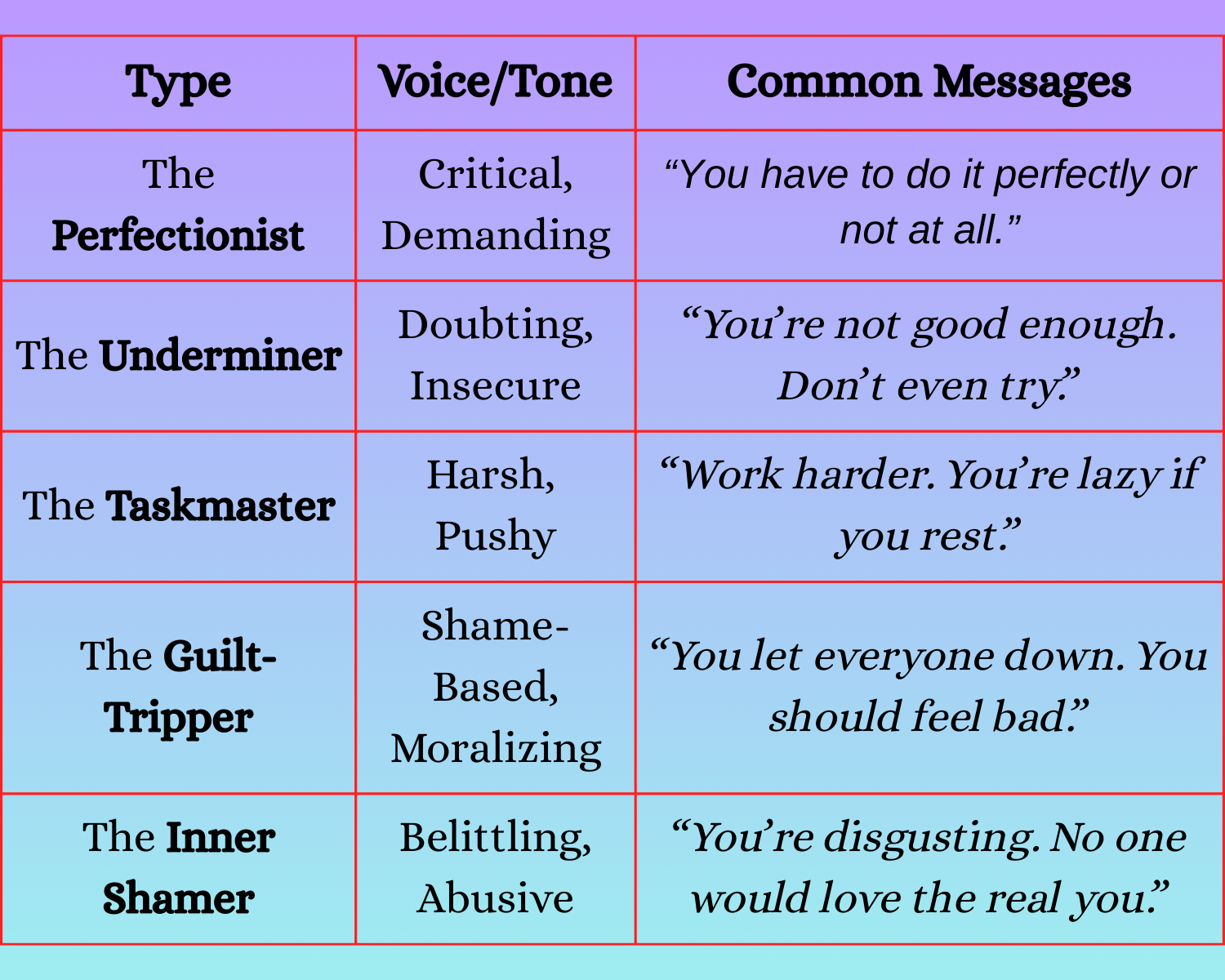
Common Inner Critic Types (Gilbert, 2010)
Understanding the “flavor” of your critic helps you detach from it and begin to rewrite the script. Psychologist Paul Gilbert, creator of Compassion-Focused Therapy (CFT), identifies several common types:
The Power of the Inner Coach
The Inner Coach is not just about “positive thinking”, it’s about realistic compassion. Your coach still holds you accountable, but with kindness. Instead of tearing you down, it guides you through challenges with patience, self-respect, and emotional safety.
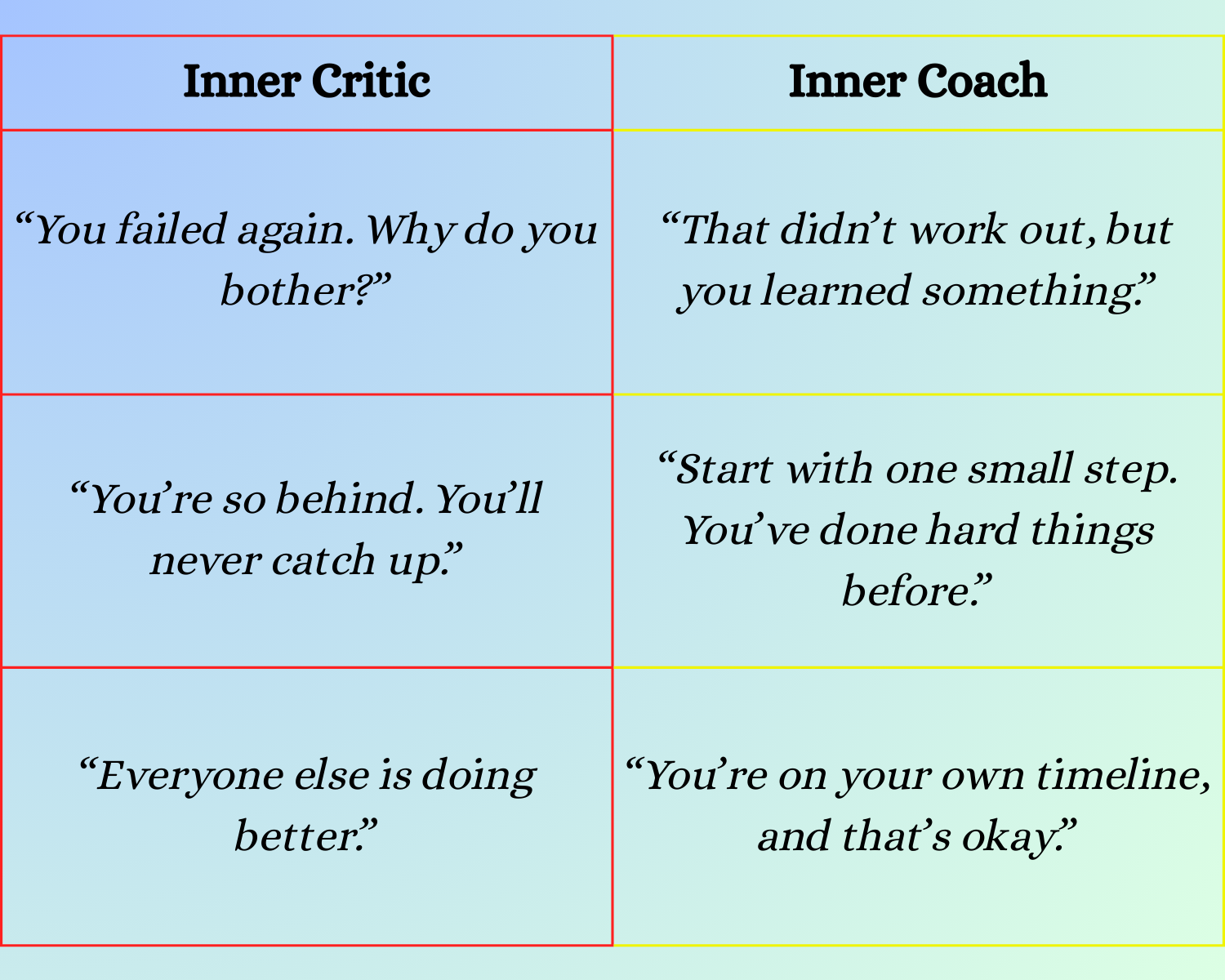
Where the critic uses shame to motivate, the coach uses encouragement and care.
From Shame-Based Motivation to Compassionate Accountability

Shame often shuts us down, while self-compassion actually increases motivation.
According to Dr. Kristin Neff’s research (2011), people who practice self-compassion are:
More resilient after failure
More likely to take responsibility
Less likely to procrastinate
Less likely to burn out
You don’t have to bully yourself into success. In fact, the most sustainable growth comes from an inner voice that supports, not sabotages.
Guided Exercises to Shift Your Inner Narrative
1. Identify Your Inner Critic
Purpose: Increase awareness of your critical voice so it no longer operates automatically.
Step-by-Step Instructions:
Choose a moment when you felt ashamed, anxious, or like you weren’t “enough.”
Write down everything your Inner Critic said.
What specific phrases did it use?
What tone did it use (sarcastic, angry, disappointed)?
When is it most active (e.g., before a social event, during work, after mistakes)?
Optional: Give your critic a name or character. This helps externalize it (e.g., “The Drill Sergeant” or “Ms. Never Enough”).

Example:
“You’re so behind — you’re lazy and you’ll never make it.”
Tone: Harsh, panicked
Trigger: Looking at my to-do list
Name it: The Couch Potato
2. Write Your Inner Coach Script
Purpose: Build your Inner Coach’s voice by rewriting common critical messages.
Step-by-Step Instructions:
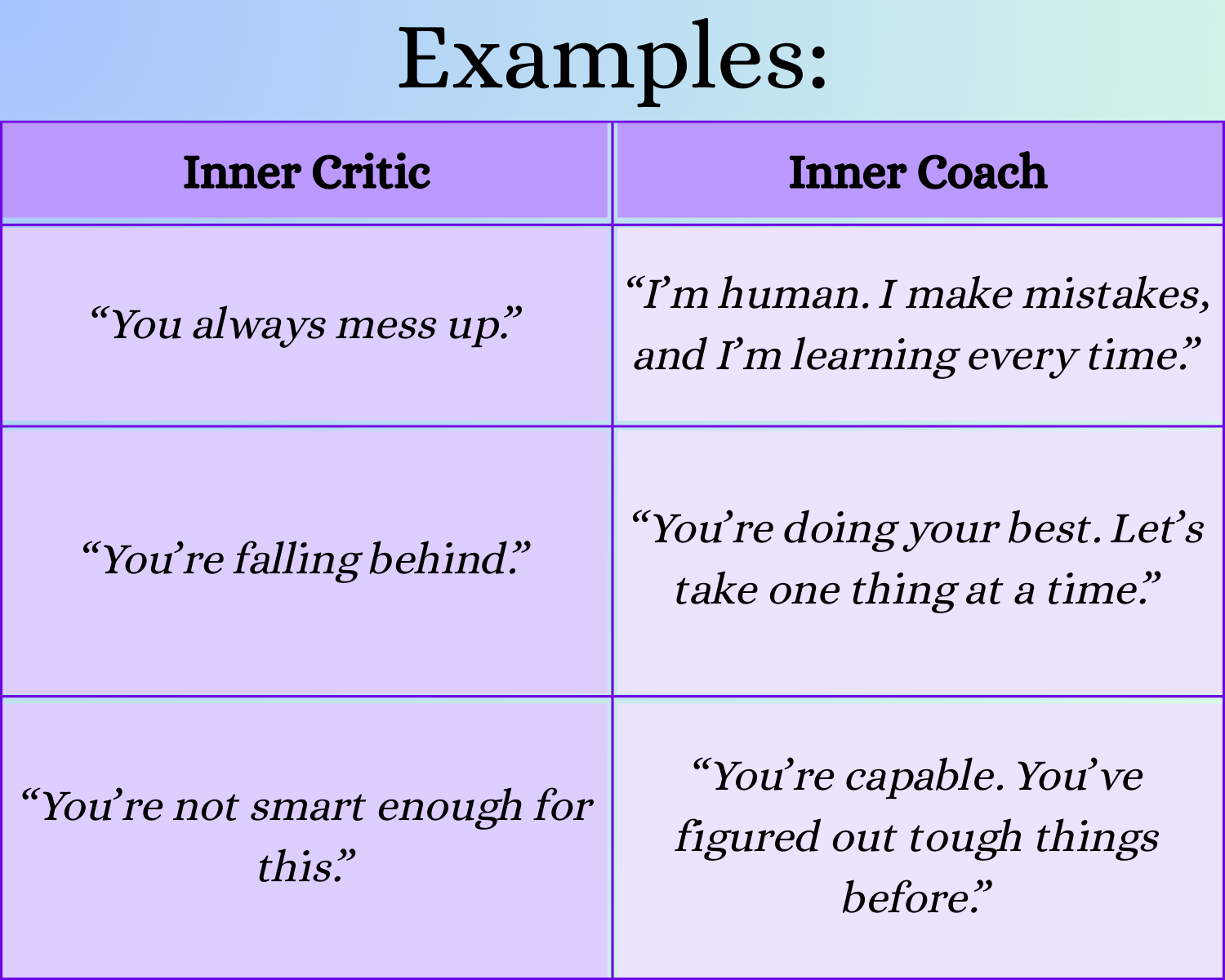
Choose 3 critical statements from the previous exercise.
For each, write a gentle, supportive response your Inner Coach might say.
Use your own voice or imagine what a caring friend or therapist might say.
Read them aloud slowly, noticing how your body responds differently to each.
3. Mirror Talk + Affirmation Practice
Purpose: Strengthen neural pathways of self-compassion and self-belief.
Step-by-Step Instructions:
Choose 1–3 affirmations that feel gentle but believable (see below).
Look into a mirror (or record a voice note) and say each one out loud once a day.
Even if it feels awkward, try to speak kindly, tone matters.
Examples:
“I am doing the best I can.”
“I deserve kindness, even from myself.”
“I am allowed to learn as I go.”

Tip: If affirmations feel fake at first, try starting with “I’m learning to…”
e.g., “I’m learning to believe that I am enough”, “I’m learning to do the best I can,” I’m learning that I am allowed to learn as I go.”
4. Motivation Anchor: Create a Sensory Reminder
Purpose: Build a physical or sensory cue that helps you reconnect with your Inner Coach in hard moments.
Step-by-Step Instructions:
Choose a visual, auditory, or tactile object that reminds you of support or growth:
A bracelet, rock, photo, quote, candle, playlist
Whenever your Inner Critic gets loud, use this anchor to shift your focus:
Touch the object
Listen to a calming song
Read or speak your affirmation
Let the anchor become your “reset button” — a reminder that you don’t have to be perfect to be worthy.

Final Thoughts
Your inner world matters. The narrator in your head shapes how you move through life. While the Inner Critic may always show up, it doesn’t have to take the lead. With intention and practice, your Inner Coach can become louder and more trusted.
This isn't about silencing the critic. It's about bringing in another voice: one that reminds you you're growing, you're trying, and you're worthy, even on the messy days.
Want Support?
If this blog resonated with you, Counseling in the Holler, LLC is here to walk alongside you. I offer trauma-informed therapy rooted in mindfulness, DBT, and self-compassion. I also accept many major commercial insurances, KY medicare, and KY Medicaid (Passport, United Healthcare, and Wellcare).
Ain’t no healing like a Holler-Healing.
References
Brown, B. (2012). Daring Greatly: How the Courage to Be Vulnerable Transforms the Way We Live, Love, Parent, and Lead. Gotham Books.
Gilbert, P. (2010). The Compassionate Mind: A New Approach to Life’s Challenges. New Harbinger Publications.
Neff, K. (2011). Self-Compassion: The Proven Power of Being Kind to Yourself. William Morrow.
Neff, K. (n.d.). Self-Compassion Research.https://self-compassion.org/the-research/